

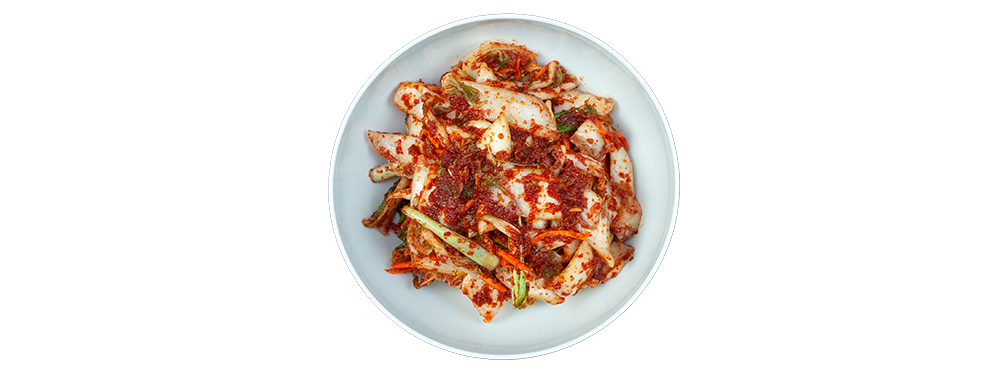
What is kimchi?
Kimchi is a traditional Korean dish made from fermented vegetables, most commonly Chinese cabbage and radish. It is prepared with a variety of spices and ingredients such as garlic, ginger, chili flakes and fish sauce. The fermentation process gives kimchi its distinctive sour taste and its health benefits as it is rich in probiotics.
The fermentation process
During fermentation, sugar is converted into lactic acid by lactic acid bacteria. These bacteria can be found almost everywhere - on celery, on your skin or simply in the air. They have a big advantage over many other bacteria: salt cannot harm them and they can work without oxygen.
Preparation and salt treatment
The salt you use to treat the celery cabbage kills unwanted bacteria. A jar filled with liquid ensures that no oxygen can enter, which also eliminates unhelpful bacteria. For the process to work as intended, the cabbage must be completely covered with liquid. If this is not the case, mold can form.

Monitoring the fermentation process
Immediately after filling the jar, you won't be able to completely cover it with liquid: the kimchi needs to slowly lose its water first. After a month at the latest, you should check whether everything is covered with water. If not, press the kimchi a little deeper into the jar.
Suitable preserving jars
In principle, all preserving jars are suitable, but we recommend jars with a loosely placed lid. Fermentation can produce gases that can cause a completely filled and closed jar to shatter. A loosely placed lid does not allow oxygen to penetrate, but can give way if a lot of gas is produced.

Storage and temperature
It is best to store the kimchi at 4-5°C during fermentation. Most refrigerators in Germany are set a little warmer, but this is not a problem and still works without any problems.


Hello, I'm Jihye, co-founder of Viamundi. I come from Korea and have been married to my German husband Philipp for over 5 years. We have a 3-year-old daughter together. We love cultural exchange and that's where the idea for our surprise food boxes from foreign countries came from!



Leave a comment
This site is protected by hCaptcha and the hCaptcha Privacy Policy and Terms of Service apply.